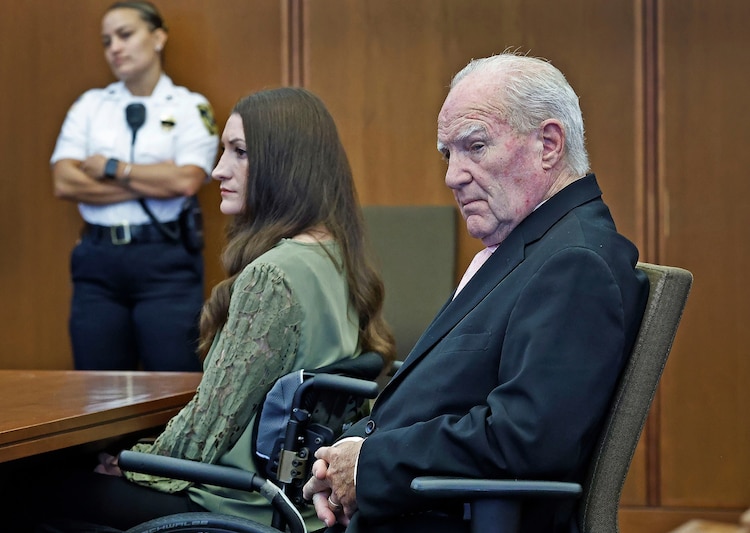
 Lindsay Clancy and lawyer Kevin Reddington look at jurors / Greg Derr/Pool via AP
ON THE NEWS
Lindsay Clancy trial declared a mistrial. What happens next? -- ABC News, Sept. 4, 2026:
After nearly 40 hours of deliberations, the jury in the murder trial of Lindsay Clancy was unable to reach a unanimous verdict, resulting in a mistrial.
Yet another Social
DOC NGU's DOODLE
[9/20/26] - The Defense sought "Not Guilty by Reason of Insanity". The Prosecution sought "Guilty of First-Degree Murder". Was there a "Guilty but Mentally Ill", that looked like a middle ground? Let's consult Google Gemini.No, "Guilty but Mentally Ill" (GBMI) was not offered to the jury in the Lindsay Clancy trial.1. Massachusetts Does Not Have a GBMI Verdict
Massachusetts is one of roughly 30 states that does not offer a Guilty but Mentally Ill statutory verdict option. Under Massachusetts state law, the jury in a criminal homicide case is presented with a strict binary regarding a defendant's mental state:
2. The Prosecution's Burden in Massachusetts
In Massachusetts, once a defendant presents sufficient evidence of a mental disease or defect (such as postpartum psychosis), the burden of proof sits entirely on the prosecution to prove beyond a reasonable doubt that the defendant was criminally responsible at the time of the offense.Because there was no GBMI option to serve as a middle ground, the jury was forced into an all-or-nothing choice on the issue of criminal responsibility. This structural constraint was a primary driver of the deadlock—11 jurors concluded the state failed to prove criminal responsibility beyond a reasonable doubt (favoring an insanity acquittal), while 1 holdout juror refused to sign off on an acquittal, triggering the mistrial.


No comments:
Post a Comment